
Shoe Molding vs. Quarter Round: Which one is better?
⚡ Quick Answer: Shoe molding is taller than it is wide (~½″ × ¾″), more flexible, and ideal for small gaps, hardwood, tile, and modern interiors. Quarter round is a perfect quarter circle (¾″ × ¾″), covers larger gaps, and suits laminate, vinyl plank, and traditional styles. Both are nailed into the baseboard — never the floor.
🔨 Royal Painting Edmonton recommends: Shoe molding for hardwood & tile · Quarter round for laminate & vinyl plank.
Shoe molding and quarter round both cover the expansion gap between flooring and baseboards but they’re not the same. Shoe molding (also called base shoe) has a taller-than-wide, subtly flattened profile (~½″ deep × ¾″ high), making it ideal for modern or minimalist interiors, smaller gaps, and uneven surfaces. Quarter round has a perfectly symmetrical quarter-circle profile (¾″ × ¾″), making it better for larger gaps, floating floors like laminate or vinyl plank, and traditional or classic interior styles. For most Edmonton homes: use shoe molding for a sleek, discreet finish; use quarter round for maximum gap coverage and a classic look.
Royal Painting Edmonton installs and paints both types regularly. Our professional pick: shoe molding for hardwood and tile with small gaps, quarter round for laminate and vinyl plank with larger expansion gaps.
Understanding the Contenders: Defining Shoe and Quarter Round Molding
Before diving deeper into the comparison, let’s clearly define each type of molding.
What is Shoe Molding?
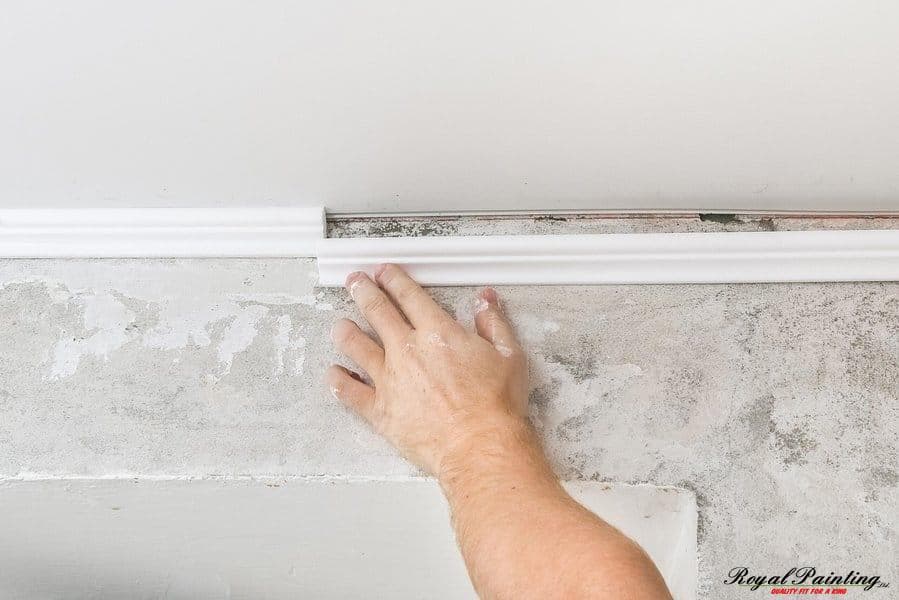
Shoe molding, also known as “base shoe,” is a thin strip of trim installed along the bottom edge of baseboards. Its primary function is to conceal the gap between the baseboard and the flooring material. Visually, it’s distinguished by its profile, which is typically taller than it is wide. While curved, the curve is often less pronounced than that of quarter round, sometimes appearing slightly flattened, angled, or resembling a sliver of an oval. This slimmer profile allows it to sit more discreetly against the baseboard and floor.
What is Quarter Round Molding?
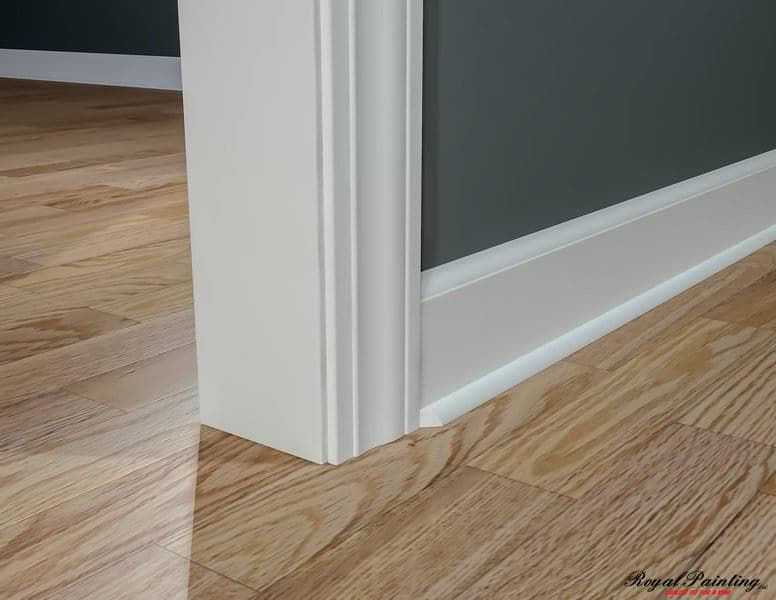
As its name explicitly states, quarter round molding has a cross-section profile that is precisely one-quarter of a full circle. Its height and depth are typically equal (e.g., 3/4 inch by 3/4 inch). This consistent, rounded shape creates a smooth, convex curve where the wall meets the floor. Like shoe molding, it covers expansion gaps but its more substantial, symmetrical profile often makes it more visually prominent.
Key Differences Explored
While both moldings bridge the gap between baseboard and floor, their differences influence selection based on practical needs and design preferences.
Shape and Profile: The Defining Feature
Quarter Round’s Consistent Curve
The defining characteristic of quarter round is its perfect 90-degree arc, forming a quarter circle. This symmetrical shape gives it a classic, rounded edge.
Shoe Molding’s Subtle Profile
Shoe molding deviates from the perfect circle. It’s typically taller than it is deep (e.g., 3/4″ high x 1/2″ deep). Its curve is often less pronounced, sometimes appearing more elliptical or slightly squashed. This subtle difference means it projects less from the wall, offering a sleeker look.
Size and Dimensions: Covering the Gap
Quarter Round for Larger Gaps
Standard quarter round sizes, often 3/4″ x 3/4″, provide more substantial coverage. This makes it a better choice for hiding larger or more uneven expansion gaps, which can occur with floating floors (like laminate or vinyl plank) or in older homes where floors and walls may not be perfectly level.
Shoe Molding for Tighter Fits
With typical dimensions like 1/2″ x 3/4″, shoe molding covers less area. It’s ideal for situations where the gap is minimal and a less obtrusive trim is desired, often preferred with traditional hardwood or tile installations.
Flexibility: Conforming to Surfaces
Shoe Molding’s Advantage
Due to its thinner profile, shoe molding (especially in wood or flexible PVC) tends to be more pliable than quarter round. This allows it to conform better to slight irregularities or curves in floors or baseboards, resulting in a tighter, more seamless fit against uneven surfaces.
Quarter Round’s Rigidity
The thicker, more uniform profile of quarter round makes it relatively stiffer. While still manageable, it might not hug minor dips or bows in the wall or floor quite as tightly as shoe molding can.
Aesthetic Appeal: Modern vs. Traditional
Shoe Molding’s Sleekness
Many designers and homeowners prefer shoe molding for its less bulky appearance. Its subtle profile blends more seamlessly with the baseboard, contributing to a cleaner, more modern, or minimalist aesthetic. It doesn’t draw as much attention to itself.
Quarter Round’s Classic Look
The more pronounced curve of quarter round gives it a more traditional and substantial look. It creates a softer transition visually but is more noticeable than shoe molding. It can complement more decorative baseboard styles or add a classic touch to a room.
Material Options
Both shoe molding and quarter round are widely available in various materials to suit different needs, budgets, and applications:
- Solid Wood: Options like Pine, Oak, Poplar, and Maple are common. They can be stained to match hardwood floors or painted. Oak is durable, while Poplar is often used for painted trim due to its smooth surface.
- MDF (Medium-Density Fiberboard): A budget-friendly option that comes pre-primed for painting. It’s smooth and consistent but less resistant to moisture than wood or PVC.
- PVC / Polystyrene / Composite: These synthetic options are excellent choices for moisture-prone areas like bathrooms, kitchens, and basements as they are resistant to water, mold, and insects. They are typically painted.
Quick Comparison Table
| Feature | Shoe Molding | Quarter Round |
|---|---|---|
| Profile Shape | Taller than wide, subtle elliptical curve | Perfect quarter-circle, symmetrical |
| Typical Dimensions | ½″ deep × ¾″ high | ¾″ deep × ¾″ high |
| Gap Coverage | Best for gaps under ½″ | Best for gaps over ½″ |
| Flexibility | More flexible — conforms to uneven surfaces | Less flexible — may show gaps on uneven floors |
| Best Floor Types | Hardwood, tile | Laminate, vinyl plank (floating floors) |
| Aesthetic Style | Modern, minimalist, discreet | Traditional, classic, pronounced |
| Material Options | Wood, MDF, PVC | Wood, MDF, PVC |
| Installation | Nail into baseboard only | Nail into baseboard only |
| Price | Comparable (depends on material) | Marginally less expensive |
| Pro Painter Pick | ✅ Hardwood & tile | ✅ Laminate & vinyl plank |
Making the Choice: When to Use Shoe Molding vs. Quarter Round
The decision often comes down to a few key factors:
Consider the Gap Siz
- Small Gaps (< 1/2 inch): Shoe molding is typically sufficient and offers a less obtrusive look.
- Large Gaps (> 1/2 inch): Quarter round provides better coverage and is often necessary, especially with floating floors which require larger expansion zones.
Assess Your Floor and Wall Condition
- Uneven Surfaces: Shoe molding’s flexibility makes it a better choice for conforming to imperfections.
- Straight, Level Surfaces: Either molding will work well, so the choice becomes more about aesthetics.
Match Your Home’s Style
- Modern/Contemporary/Minimalist: The sleek, subtle profile of shoe molding often fits best.
- Traditional/Classic/Ornate: The more pronounced curve of quarter round can complement these styles well, or shoe molding can still be used if a less prominent trim is preferred.
Factor in Existing Trim
Consistency is often key. If the rest of your home uses one type of molding, sticking with it can create a more cohesive look. However, different rooms or flooring types might justify using different moldings.
Installation Essentials
While installation methods are similar for both, precision is key for a professional finish.
- Measure Carefully: Measure each section accurately. For corners, a miter saw set at 45 degrees is typically used for clean inside and outside corners. Coping inside corners is another technique preferred by professionals for a tighter fit.
- Cut Precisely: Ensure your cuts are clean and accurate. Test fit pieces before nailing.
- Nail to the Baseboard: This is critical! Use an 18-gauge brad nailer or finish nails. Always nail the shoe molding or quarter round *into the baseboard*, not downwards into the flooring. This allows the floor to expand and contract freely underneath the trim without buckling or causing nail pops.
- Finishing: Fill nail holes with wood putty that matches your trim color (or use paintable filler if painting). Caulk the top seam where the molding meets the baseboard for a seamless look, especially if painting.
- Acclimation: If using wood molding, let it acclimate inside the room for at least 48 hours before installation to adjust to the home’s humidity level.
Frequently Asked Questions (FAQ)
– Can shoe molding and quarter round be used interchangeably?
Functionally, yes, to some extent, as both cover gaps. However, their different profiles create distinct looks. Quarter round covers larger gaps more effectively. Shoe molding offers a more subtle appearance and better flexibility for uneven surfaces. While technically interchangeable in some situations, choosing based on gap size and desired aesthetic is recommended for the best result.
– Is shoe molding or quarter round cheaper?
Costs are generally comparable and depend more on the material chosen (MDF < Pine < Oak/PVC) than the profile itself. Basic primed MDF versions of both are very affordable. Hardwood options will be more expensive. Sometimes, quarter round might be slightly cheaper due to its simpler, symmetrical profile being easier to mill, but the difference is usually minimal.
– Do I always need shoe molding or quarter round with baseboards?
Not always, but it’s highly recommended, especially with hard surface flooring like wood, laminate, vinyl plank, and tile. These floors require an expansion gap around the perimeter. Shoe molding or quarter round is the standard way to cover this gap cleanly. Some installers might install baseboards after the floor, leaving only a tiny gap that can sometimes be caulked, but this is less common and doesn’t work well for floors needing significant expansion space (like floating floors). Using trim provides a more professional and durable finish.
– Should the shoe molding or quarter round match the floor or the baseboard?
Typically, shoe molding or quarter round is painted or stained to match the baseboard trim, not the floor. This creates a visually cohesive look, making the baseboard appear taller and more substantial. Matching the floor is less common but can be done if preferred, though it can sometimes make the transition look disjointed.
🏆 Royal Painting Edmonton’s Verdict
Choose Shoe Molding if: Your gap is under ½ inch, you have hardwood or tile floors, your walls or floors are slightly uneven, or you want a sleek modern finish that blends discreetly with the baseboard.
Choose Quarter Round if: You have laminate, vinyl plank, or other floating floors with larger expansion gaps, your home has a traditional or classic interior style, or you need maximum gap coverage.
Not sure which is right for your space? Contact Royal Painting Edmonton — our team can advise and install both types professionally.